
One month in - what's going on?
- Nathalie Gardiner
- Oct 27, 2025
- 4 min read

Well gang, it's all been happening at the big university on my computer.
I started my course on the 4th of October 2025 and so far, so good! I'm enjoying the mix of maths and engineering, scheduling seems to be working out, only a little stress from studying full-time while also still working, but we survive and we succeed.
Structure is everything - not just in engineering - and the past few weeks have taught me a lot on how to manage my time, manage my expectations, and also how to still go out for a run when your day is packed from 9am - 9pm.
Mostly, though, it's been about how maths and engineering are two dialects of the same language: one analytical, one applied, both gorgeous.
Engineering - an unexpected start
I started off this engineering module - Origins, Methods and Context - a little apprehensive. There seems to be a lot of focus on study skills, which I will agree are very useful, but it's not exactly what I expected from this module. I was expecting more of an immediate dive into formulas and friction, but we spent a lot of time making study planners on Excel.
I concede that the initial focus turned out more useful than I realised. We started getting into aspects of Personal Development Plans, maintaining a log of all that we do (reminds me of something...), and of course, managing time and approaching problems methodically are as essential to engineering as equations are. The sooner you get organised, the better your models (and mental health) will be.
The textbooks and tutorial clips have interesting examples of communication, experiments, a little historical context of how engineering became the field it is today. That began to lift the fog I felt at the planning stage, as we jumped back into familiar territory - equations, scale factors, Newton's laws. I rediscovered that I'm still not super at converting into SI units (miles per minute, anyone?), and that the BMI is arbitrary. I wasn't expected to bring the uselessness of BMI into my engineering studies, but indeed, life has a way.
We studied strain, and what an opportunity that was to connect to another one of my passions: crochet. Us yarn artists, we see strain first hand. Make a strap too loose and your crochet top becomes a dungaree skirt. It's great knowing that the same physics governing spacecraft also explains my droopy sleeves.
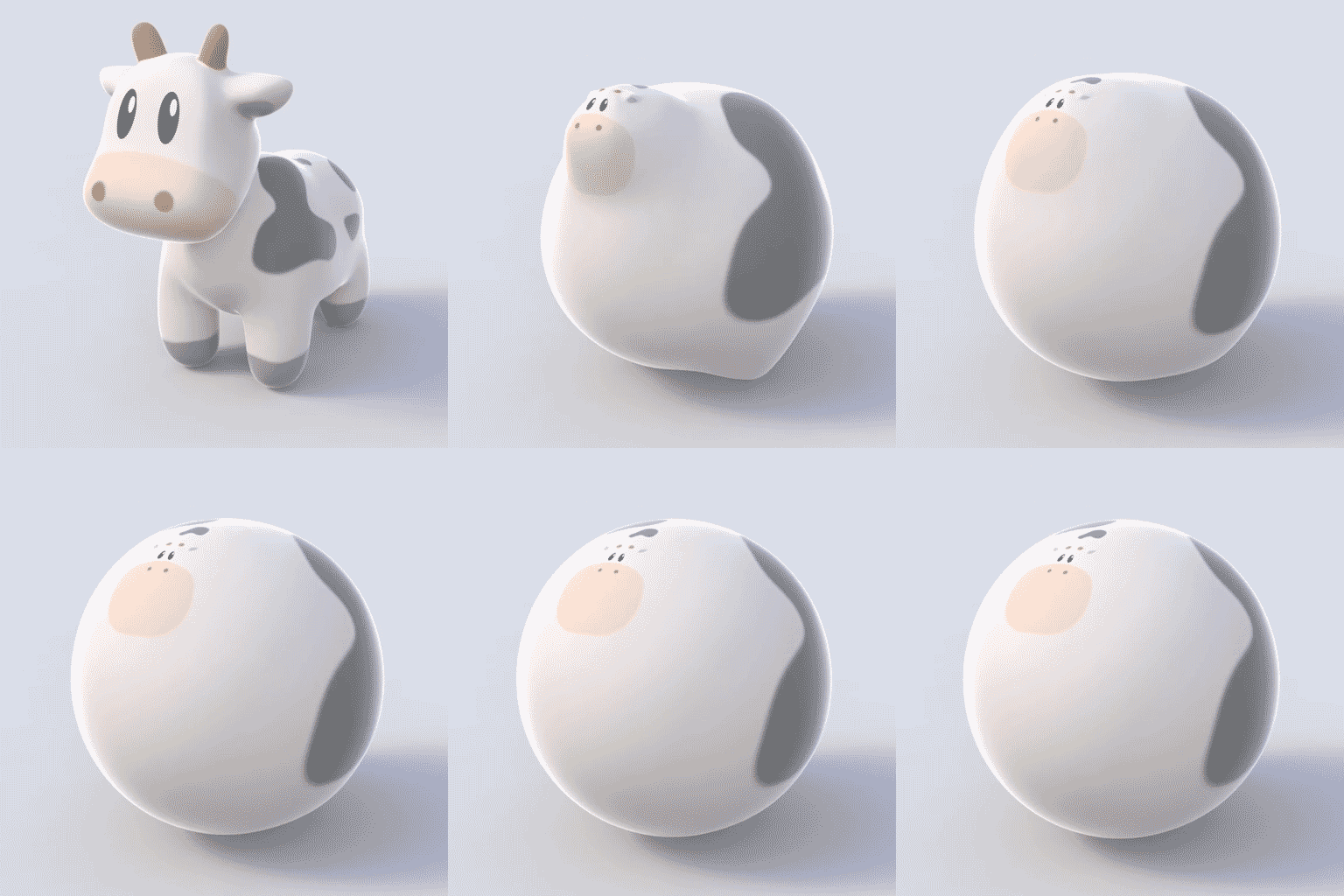
We studied quite a few diverse topics over these 3 weeks, but we just finished with the modelling cycle, so it's on my mind. The modelling cycle feels intuitive to me, but it reminds me that good engineering isn't just about calculation, it's about framing the right problem. We looked at the Transport Direct system of ye olde internet, route planning, scale factors, the usual. And how one must assume a perfectly spherical cow, of course. But it's not about being right the first time, it's about trying, failing and learning. Like me with SI units. Still.
The Mathematics of Brunch
Did you know that René Descartes, despite making us do the algebra we signed up for, was also a sound guy? He refused to get out of bed until 11am, saying it was a prerequisite for doing good maths. And I would tend to agree. Morning people baffle me.
It's hard to write a blog post about maths without being boring, so I will summarise what we have done:
Numbers - wow!
Algebra
Roots and powers (the number of times I yelped when I got a question right has scared my cats more times than it should have)
Graphs and equations
It's a good return to precision. To know there is always a correct answer (so far), and to know it's not all just abstract, but a toolkit for understanding relationships, systems and change.
Assessment takes a while to write out, but because the assessments can be done over a few weeks and they are open book, they give time to really deepen understanding, and add a few more success-yelps to the tally.
Also, I seem to be the only one of my cohort to think wxMaxima is very sexy indeed.
Find the equation of the line when m = engineering and c = maths
My engineering and maths modules aren't formally linked, but they're starting a to weave together in my head. It's all part of the same language, and it's becoming clearer that engineering doesn't just use maths, it is maths, but with a little bit of creative spice. Equations are tools, not chores as I seemed to think at the age of 16.
To me, engineering brings maths to life, gives it context and a reason to actually care about the result, not just checking the solutions in the back of a book to get a nice green tick. Maths is the bones of engineering, keeping the whole thing upright and coherent.
Maths and engineering at their core are about patterns, reasoning and creativity, three things that have shaped my career so far and will definitely continue into my future. It's about the beauty of finding order in complexity.
But not before 11am.

Comments